General
Why Nobody Wants to Drive the Roller
Frederik Filz-Reiterdank
CEO, Crewline AI

Zach, the owner of Watts Services, told me six months ago that he cancels two out of every three jobs because he doesn't have enough operators.
He's not unusual. He's typical. Contractors everywhere are turning down work because there's no one to run the machines. I've seen it firsthand - I built my last construction company to $30M+ revenue and 100 people in two years and the labor shortage was the single biggest constraint on growth.
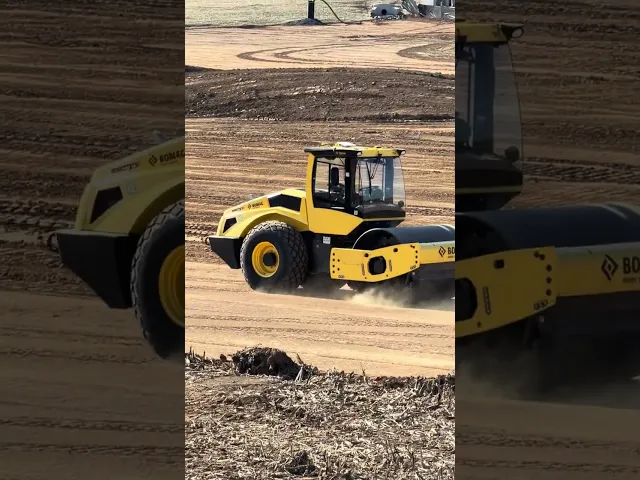
So we built a roller that drives itself.
Why the Roller
Nobody wants to operate the roller. It's the most repetitive, lowest-skill task on any earthworks site. There's zero pushback from crews when you automate it - they're relieved.
Rollers are also predictable. They move slowly in straight lines over defined areas. That makes them the least intimidating autonomous vehicle you can put on a job site - this matters for adoption.
And here's the part most people miss - you can't just start with the excavator or the dozer. Those operators are the senior people on site. They don't just run a machine - they direct other operators, read the grading plan, make real-time decisions about cut and fill. They're part of the orchestration layer. Automating those machines requires high-level project context that doesn't exist in any system yet. The roller doesn't. It takes a zone and compacts it. That's a solvable problem today.
The roller is the wedge. After that: bulldozers, motor graders, dump trucks, wheel loaders, excavators. The long-term vision is fully end-to-end automated construction - where earthworks, foundation and building assembly become a repeatable, scalable industrial process.
How It Works
We retrofit your existing roller in about an hour - no wire cutting, fully reversible. The foreman draws the working area on an iPad or drives the perimeter, approves the proposed rolling route and hits Go. The roller compacts autonomously inside the zone, stopping for people, vehicles and obstacles. Update the zone as the job changes or flip back to manual anytime.
Same crew, more output.
Why Now
Our machine can recognize a new construction-specific hazard - a survey stake, a manhole cover, a pipe - from a text description and a handful of reference images. Two years ago, that wasn't possible.
Under the hood, our perception system runs stereo depth, on-edge object detection and large vision-language models - with a real-time safety system running 360° detection and geo-fence enforcement. The underlying foundation models and dramatically better sensor suites have crossed a threshold where autonomous heavy equipment is a deployable product, not a research project.
It's not that contractors won't adopt technology - it's that hardware automation has never actually worked on a construction site.
Real Sites, Real Results
We closed Dynamic Site Solutions as a customer within 24 hours of first contact.
On their 30-acre airport extension in Austin, Texas, daily downtime dropped from six hours on day one to under one hour by the end.
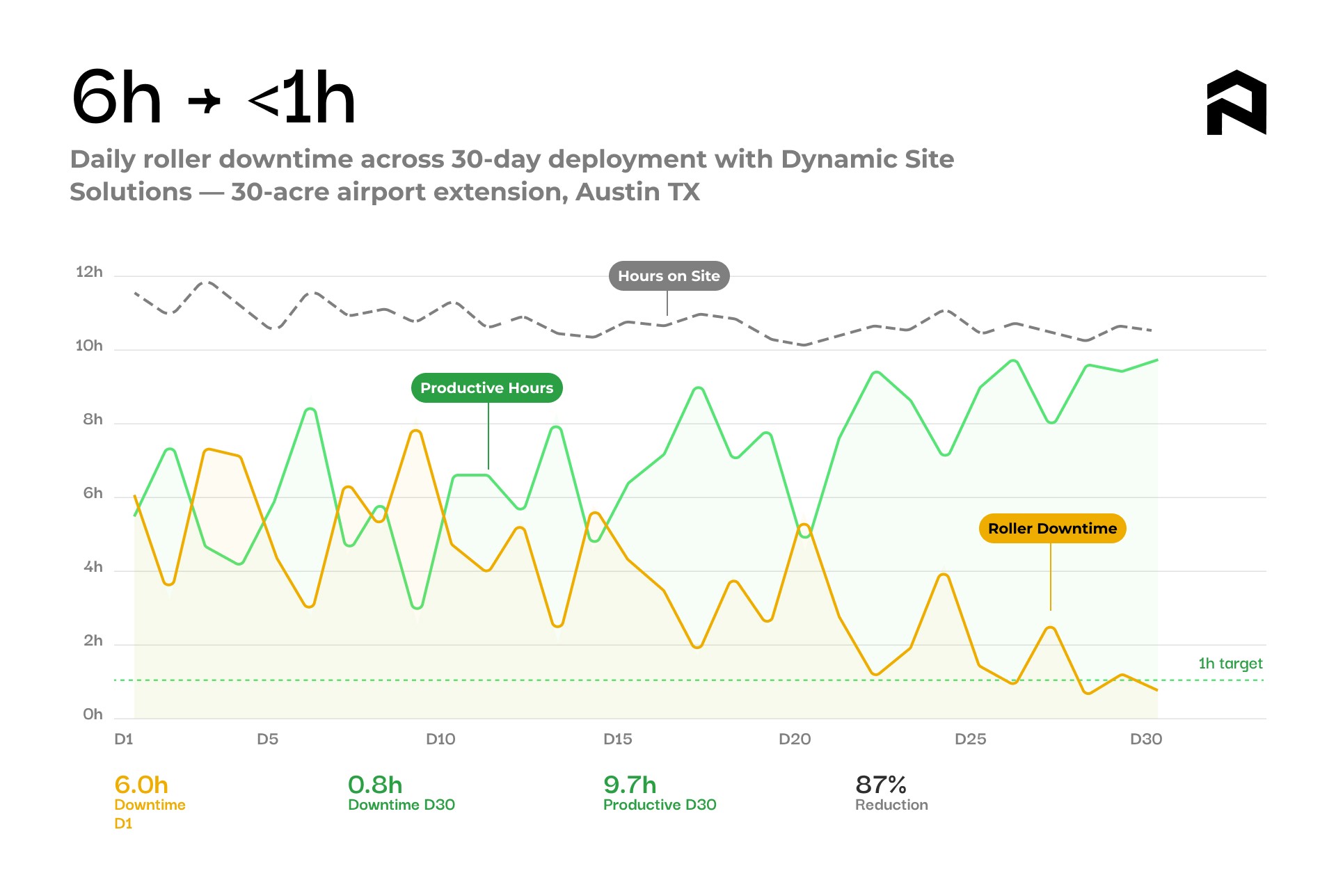
Total hours on site stayed flat. Productive hours nearly doubled during 30-day deployment with Dynamic Site Solutions, Austin TX.
We've since redeployed to Philadelphia with Watts Services, where we're scaling from one roller to three across multiple sites. Zero accidents. Zero near-misses.
"I didn't believe it would work until I saw it run for eight hours straight." - Zach Watts, Owner of Watts Services
Our pipeline includes deployments with Bechtel and Haydon Companies. We've completed site visits with Mortenson, Ames, MasTec and dozens of other contractors across Texas, Georgia, Arizona, Nevada and Pennsylvania. Since ConExpo 2026, 241 contractors have joined our waitlist - representing over $26M in potential annual contracts.
Today, we're announcing our $7.1M seed round, led by Initialized Capital and Nebular. Rollers are just the beginning.
We're Hiring
We're four people. We're on our sixth hardware kit. My cofounder and CTO Mohamed built the entire autonomy stack from scratch. Niall, our founding hardware engineer, built the world's first student reusable bipropellant rocket at MIT. Everyone on the team earned their seat.
We're looking for perception and robotics engineers. Your first week, you'll be on a job site with the system running next to you. By week four, your code is on a machine compacting soil on an active construction site. You'd own 3D perception pipelines, sensor fusion, obstacle detection and safety systems end-to-end - from embedded compute on the machine to vision-language models in the cloud.
In return: true ownership of critical systems, meaningful equity at the right stage and colleagues who all cleared the same bar you did.
If that sounds like you - or someone you know - reach out. Even if it's not a match, I always provide feedback.
Frederik Filz-Reiterdank
CEO, Crewline AI
Related Blogs


